|
Effectiveness
Several factors need to be considered in the
surgical management of acromegaly:
Risk of complications is related to tumor size
and the type of surgical procedure used, the most
common procedure being transsphenoidal surgery.
Recent retrospective studies of the results of
surgical treatment for acromegaly showed that
the risk of postoperative complications was 5%
to 8%.16,17
Transsphenoidal
Surgery
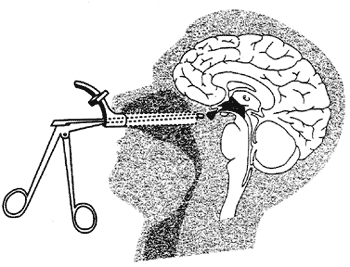
The most commonly used procedure for removal
of adenoma from the pituitary is transsphenoidal
surgery. In this procedure, a neurosurgeon enters
through the nose and approaches the pituitary
through the sphenoid bone at the base of the skull
(Fig 6). Occasionally, large pituitary tumors
may require transcranial surgery, in which the
surgeon cuts into the skull (above the eye and
ear) and retracts a portion of the brain to reach
the tumor.
Figure 6. Transsphenoidal Surgery.
Biochemical Cure After Surgery
A recent retrospective study of 162 patients
who underwent surgery for acromegaly between 1978
and 1996 used a stringent definition of biochemical
cure: GH <2.5 ng/mL after OGTT and normalization
of the IGF-I level.16 The overall surgical
cure rate was 57%, but was 91% for microadenomas
and 48% for macroadenomas. Adjuvant radiation
and/or pharmacologic therapy was given to 61 patients.
The 10-year survival rate was 88%, and there was
no difference in mortality between the patients
in remission and a control sample. They concluded
that the decreased survival associated with acromegaly
can be normalized by bringing GH levels to <2.5
ng/mL through surgery and adjunctive therapy with
radiation and/or pharmacologic agents.16
An increased mortality rate and a reduction of
life expectancy are the most serious risks associated
with uncontrolled acromegaly.18
Options: When Surgery Fails
When surgery fails to normalize IGF-I levels
or sufficiently reduce GH levels, acromegalic
patients have the following options:
Second surgery, however, is rarely successful.
 |
Only
15% of patients achieve biochemical remission.19
|
|
The risks associated
with repeat transsphenoidal surgery are significantly
greater than the procedure in a previously
untreated patient.20 |
References:
| 1.
|
Acromegaly
Therapy Consensus Development Panel. Consensus
statement: benefits versus risks of medical
therapy for acromegaly. Am J Med.
1994;97:468-473. |
| 16.
|
Swearingen
B, Barker FG II, Katznelson L, et al. Long-term
mortality
after transsphenoidal surgery and adjunctive
therapy for acromegaly. J Clin
Endocrinol Metab. 1998;83:3419-3426. |
| 17.
|
Abosch
A, Tyrrell JB, Lamborn KR, et al. Transsphenoidal
microsurgery
for growth hormone-secreting pituitary adenomas:
initial outcome and
long-term results. J Clin Endocrinol
Metab. 1998;83:3411-3418. |
| 18.
|
Bates
AS, Van't Hoff W, Jones JM, et al. An audit
of outcome of
treatment in acromegaly. Q J Med.
1993;86:293-299. |
| 19.
|
Giovanelli
M, Mortini P, Giugni E, et al. Surgical
treatment of
acromegaly. In: von Werder K, Fahlbusch
R, eds. Pituitary Adenomas: From
Basic Research to Diagnosis and Therapy.
New York, NY: Elsevier; 1996:21-29. |
| 20.
|
Laws ER, Jr, Fode NC, Redmond MJ. Transsphenoidal
surgery following unsuccessful prior therapy.
An assessment of benefits and risks in 158
patients. J Neurosurg. 1985;63:823-829.
|
|