|
Subcutaneous
Sandostatin®
(octreotide acetate) Injection
Octreotide is a potent inhibitor
of GH, and adenomas have large numbers of receptor
sites for this peptide. Therefore, octreotide
administration has proven successful in the treatment
of acromegaly.21-24 Studies show that
subcutaneous
Sandostatin Injection administered provides
the following:
Subcutaneous Sandostatin® Injection Clinical
Results
Long-term results of 103 acromegalic patients
participating in a multicenter trial evaluating
the safety and efficacy of subcutaneous
Sandostatin Injection were reported by Newman
et al.24
Figure 8. Mean GH levels shown before
and during octreotide treatment. The number of
patients evaluated at each time point is shown
in parentheses.
Adapted with permission from Newman et al.24
Development
of Sandostatin LAR® Depot (octreotide
acetate for injectable suspension)
Despite the established efficacy of octreotide
acetate and its advantages over native somatostatin,
the inconvenience of multiple daily subcutaneous
injections to maintain therapeutic drug levels
has remained a practical deterrent to both patients
and physicians. A long-acting release formulation
was developed to address the limitations of the
subcutaneous
Sandostatin® (octreotide acetate) Injection
formulation.15,26
 |
Sandostatin
LAR® Depot incorporates octreotide into
microspheres of the biodegradable glucose
star polymer, D,L-lactic and glycolic acids
copolymer.26 |
|
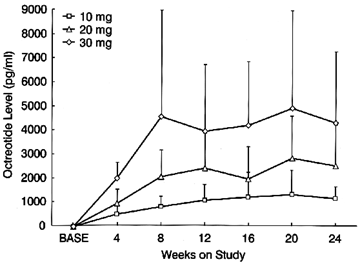
Slow drug release
accompanies the biodegradation of the polymer
ester bond through hydrolysis (Fig 9).27
|
Figure 9. Sandostatin LAR® Depot formulation
releases octreotide slowly over time.
Click here
for prescribing information for Sandostatin LAR®
Depot
Potential
Advantages of Sandostatin LAR® Depot
(octreotide acetate for injectable suspension)
Pharmacokinetics
and Pharmacodynamics of Sandostatin LAR® Depot
(octreotide acetate for injectable suspension)
Fløgstad et al29 reported the
results of 2 double-blind studies that examined
single intramuscular (IM) doses of Sandostatin
LAR® Depot given at 3, 6, 9 and 12 mg, and
20 and 30 mg, respectively, in 21 acromegalic
patients. All patients had elevations in basal
GH levels that were not suppressed during an OGTT,
and elevations in IGF-I. Furthermore, all had
previously shown good GH suppression with subcutaneous
Sandostatin® (octreotide acetate) Injection
during a 2- to 4-week pretreatment period. The
following results were reported:
Clinical
Study Design for Efficacy Determinations
The efficacy of Sandostatin LAR®
Depot (octreotide acetate for injectable suspension)
for treatment of acromegaly was examined in 3
major trials.
|
In
studies 1 and 2, 101 patients were enrolled.
Treatment was monitored for 27 months. |
|
In study 3, 151 patients were enrolled.
Treatment was monitored for 12 months.
|
The primary efficacy variable
in these trials was GH level. Secondary efficacy
variables were IGF-I level and clinical symptoms/signs
of acromegaly. Adverse events and vital signs were
also monitored.
Because Sandostatin LAR® Depot
is appropriate for patients who have been shown
to respond to and tolerate subcutaneous
Sandostatin® (octreotide acetate) Injection,
clinical trials of Sandostatin LAR® Depot
were performed in patients who had been receiving
subcutaneous
Sandostatin® Injection for periods ranging
from a few weeks to more than 9 years.
In studies 1 and 2, patients underwent
an initial screening period in which they received
100 µg or 200 µg of subcutaneous
Sandostatin® Injection tid. They were
eligible to continue the trial if they were "good
responders" (defined in these trials as GH
<5 ng/mL and µ50% decrease in GH from
pretreatment levels).
After demonstrating a response
to subcutaneous
Sandostatin® Injection, subjects went
through a washout period of 3 days (Study 1) or
14 days (Study 2) to allow GH levels to rise to
µ5 ng/mL. Most patients then received a
single injection of 20 mg or 30 mg of Sandostatin
LAR® Depot, and were followed for 60 days.
Patients who had GH µ5 ng/mL
and 50% decrease in GH from pretreatment levels
were eligible to participate in 6-month, 9-month,
and 12-month extensions of the trial, in which
doses of 20 mg, 30 mg, or 40 mg (individually
titrated to maintain GH levels at <5 ng/mL)
were provided every 28 days. With the initial
trial and extensions, patients were monitored
for up to 27 months.
In Study 3, patients underwent an
initial screening period in which they received
100 µg to 500 µg of subcutaneous
Sandostatin® Injection, bid or tid, for
at least 4 weeks. They were eligible to continue
the trial if they achieved a mean 4-hour GH level
of <10 ng/mL. Patients were then switched,
without washout, to Sandostatin LAR® Depot,
which was provided in a dose of 20 mg every 4
weeks for 3 injections. Based on GH levels, subsequent
doses were reduced to 10 mg, increased to 30 mg,
or maintained at 20 mg for an additional 9 months.
|
Of
the total 122 patients completing 12 months
of treatment27: |
|
|
Table 2. GH Suppression During Long-Term
Treatment With Subcutaneous
Sandostatin® Injection and Sandostatin LAR®
Depot27
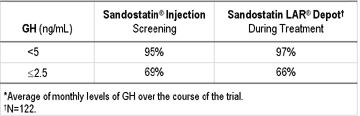
In all of these trials, mean and
median GH levels for patients treated with Sandostatin
LAR® Depot were equal to or less than those
seen when patients were treated with subcutaneous
Sandostatin® Injection. The investigators
concluded that.27
Table 3.
IGF-I Normalization (<500 µg/L) During
Long-Term* Treatment With Sandostatin LAR®
Depot27

Patients Reporting Clinical
Symptoms
The clinical trials of Sandostatin
LAR® Depot monitored symptoms as a secondary
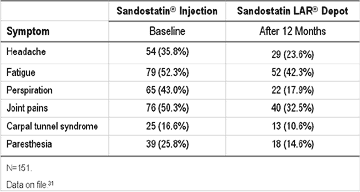
parameter. As shown in Table 4, improvement in
fatigue, perspiration, joint pain, and other symptoms
was observed, compared with baseline levels.
|
Clinical
symptoms of acromegaly were dramatically reduced
during treatment. |
|
All symptoms
were reported less frequently after 12 months
of Sandostatin LAR® Depot once-monthly
treatment than with subcutaneous
Sandostatin® Injection. |
Table 4.
Patients Reporting Symptoms of Acromegaly With
Subcutaneous
Sandostatin® Injection and Sandostatin
LAR® Depot
These findings are consistent with
results seen in trials of subcutaneous
Sandostatin Injection, in which Sandostatin
Injection therapy has reduced acromegaly symptoms.
They are also consistent with the documented relationship
between reductions in GH/IGF-I and symptom improvement.
Safety Profile
of Sandostatin LAR® Depot
Safety data were obtained from all
3 trials with the following results:
|
Clinical
symptoms of acromegaly were dramatically reduced
during treatment. |
|
All
symptoms were reported less frequently after
12 months of Sandostatin LAR® Depot once-monthly
treatment than with subcutaneous
Sandostatin®
Injection. |
|
The
body system most commonly affected in acromegalic
patients treated for 12 to 30 months was the
GI system.27 |
|
Diarrhea,
abdominal pain, and nausea developed primarily
during the first month of treatment with Sandostatin
LAR® Depot, with new cases occurring infrequently
later in treatment. |
|
Many
other adverse events also diminished in frequency
with continued therapy, with no statistically
significant differences noted between the
20-mg and 30-mg groups.32 |
|
Local
tolerability at the injection site was good;
injection-site reactions were generally mild
to moderate and dose-related.27 |
|
Short-lived injection-site
pain after IM administration-discomfort lasting
usually less than 1 hour-was reported in 2%,
9%, and 11% of patients, respectively, receiving
10 mg, 20 mg, and 30 mg of Sandostatin LAR®
Depot.27, 32 |
Adverse
Reactions of Sandostatin LAR® Depot (octreotide
acetate for injectable suspension)
Gallbladder Abnormalities:
Gallbladder abnormalities, especially stones and/or
biliary sludge, frequently develop in patients
on long-term octreotide therapy. Treatment is
usually not required but, if it is, these gallstones
can be treated similarly to those of the general
population.1, 7, 22-24
Cardiac: In acromegalics,
sinus bradycardia (<50 bpm) developed in 25%;
conduction abnormalities occurred in 10%; and
arrhythmias developed in 9% of patients during
subcutaneous
Sandostatin® Injection therapy. The relationship
of these events to octreotide acetate is not established
because many acromegalics have underlying cardiac
disease.27
Gastrointestinal:
As with subcutaneous
Sandostatin® Injection, the most frequently
reported drug-related adverse events were gastrointestinal
disorders (diarrhea, 36%; abdominal pain, 29%;
flatulence, 26%; constipation, 19%; nausea, 10%;
and vomiting, 7%), and biliary disorders (52%).27
Thyroid function:
Octreotide suppresses secretion of thyroid-stimulating
hormone, which may result in hypothyroidism. Hypothyroidism
has been reported in acromegalic patients receiving
octreotide therapy.27
Conclusions—Efficacy Profile
for Sandostatin LAR® Depot in Acromegaly
|
Consistent
therapeutic serum octreotide concentrations
. |
|
Suppression
of GH and IGF-I in response to Sandostatin
LAR® Depot in single-injection and long-term
clinical trials . |
|
Long-term
suppression of GH to <2.5 ng/mL in 47%
to 66% of patients and <1 ng/mL in 11%
to 23% of patients.27 |
|
Normalization
of IGF-I in 51% to 67% of patients of patients.27 |
|
Substantial improvement
in clinical symptoms. |
References:
| 1.
|
Acromegaly
Therapy Consensus Development Panel. Consensus
statement:
benefits versus risks of medical therapy for
acromegaly. Am J Med.
1994;97:468-473. |
| 7.
|
Melmed
S, Ho K, Klibanski A, et al. Clinical review
75: recent advances
in pathogenesis, diagnosis, and management
of acromegaly. J Clin Endocrinol
Metab. 1995;80:3395-3402. |
| 14. |
Melmed
S, Jackson I, Kleinberg D, et al. Current
treatment guidelines
for acromegaly. J Clin Endocrinol Metab.
1998;83:2646-2652. |
| 15. |
Harris
AG. Treatment of acromegaly. In: Daly
AF, ed. Acromegaly and Its
Management. Philadelphia, PA: Lippincott-Raven;
1996:49-68. |
| 21. |
Barkan
AL, Kelch RP, Hopwood NJ, et al. Treatment
of acromegaly with
the long-acting somatostatin analog SMS 201-995.
J Clin Endocrinol Metab.
1988;66:16-23. |
| 22. |
Ezzat
S, Snyder PJ, Young WF, et al. Octreotide
treatment of
acromegaly: a randomized, multicenter study.
Ann Intern Med.
1992;117:711-718. |
| 23. |
Vance
ML, Harris AG. Long-term treatment of 189
acromegalic patients
with the somatostatin analog octreotide: results
of the International
Multicenter Acromegaly Study Group. Arch
Intern Med. 1991;151:1573-1578. |
| 24. |
Newman
CB, Melmed S, Snyder PJ, et al. Safety
and efficacy of long term
octreotide therapy of acromegaly: results
of a multicenter trial in 103
patients; a clinical research center study.
J Clin Endocrinol Metab.
1995;80:2768-2775. |
| 25. |
Sandostatin®
(octreotide acetate) Injection prescribing
information.
East Hanover, NJ: Novartis Pharmaceuticals
Corporation; 1997. |
| 26. |
Lancranjan
I, Bruns C, Grass P, et al. Sandostatin
LAR®:
pharmacokinetics, pharmacodynamics, efficacy,
and tolerability in
acromegalic patients. Metabolism.
1995;44(suppl 1):18-26. |
| 27. |
Sandostatin
LAR® Depot (octreotide acetate for injectable
suspension)
prescribing information. East Hanover,
NJ: Novartis Pharmaceuticals
Corporation; 1998. |
| 28. |
Grass
P, Marbach P, Bruns C, et al. Sandostatin®
LAR®
(microencapsulated octreotide acetate) in
acromegaly: pharmacokinetic and
pharmacodynamic relationships. Metabolism.
1996;45:27-30. |
| 29. |
Fløgstad
AK, Halse J, Haldorsen T, et al. Sandostatin
LAR in
acromegalic patients: a dose-range study.
J Clin Endocrinol Metab.
1995;80:3601-3607. |
| 30. |
Kaal
A, Frystyk J, Skjærbæk C, et al.
Effects of intramuscular
microsphere-encapsulated octreotide on serum
growth hormone, insulin-like
growth factors (IGFs), free IGFs, and IGF-binding
proteins in acromegalic
patients. Metabolism. 1995;44:6-14. |
| 32. |
Lancranjan
I, Bruns C, Grass P, et al. Sandostatin®
LAR®: a promising
therapeutic tool in the management of acromegalic
patients. Metabolism.
1996;45(suppl 1):67-71. |
|