|
Evaluating
the Risks Vs the Benefits
When surgery fails or is contraindicated, radiation
therapy can be considered. Factors for consideration
in the use of radiation for acromegaly include:
| Table
5. Percentage of Patients With Different GH
Levels After Radiotherapy33 |
| Post
Radiotherapy |
GH
< 5 ng/mL (%) |
GH
< 10 ng/mL (%) |
1
yr
|
2 |
10 |
| 5
yr |
28 |
60 |
|
10 yr
|
58 |
73 |
| 15
yr |
72 |
80 |
| 20
yr |
88 |
90 |
IGF-I
Levels Rarely Normalized With Radiation
However, IGF-I levels are rarely
normalized, even when GH levels are reduced to
<5 µg/L.
 |
In
one survey by Barkan et al (1997)13
only 2 of 38 (5%), patients treated with radiation
gained normal IGF-I levels (Fig. 10). |
|
For the remaining
36 patients, IGF-I remained elevated despite
a mean plasma GH of 4.6 µg/L. |
Figure 10.
The post radiation dynamics of plasma GH and IGF-I
concentrations.
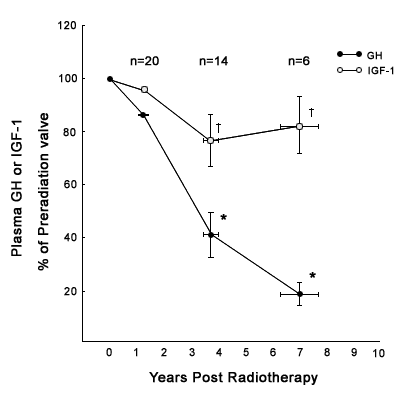
*p<.01.
†p<.05 (vs. preradiation value).
Adapted with permission from Barkan et al.13
Some studies indicate that radiotherapy
may not be effective in lowering GH to safe levels
in many patients, even after a long period of
time. For example, Thalassinos et al reported
data on 46 acromegalic patients who received external
beam megavoltage radiotherapy and were followed
for a mean of 7.6 years (range 2 to 22 years).
39
|
Following
radiotherapy, basal GH levels decreased from
a mean of 30.9 ng/mL to 11.5 ng/mL at 10 years
of follow up. |
|
Only
27% of the patients (10/48) showed a decrease
of GH levels to less than 2.5 ng/mL at their
latest follow up. |
|
Thus,
while radiotherapy was effective for decreasing
GH hypersecretion, it seldom reduced GH levels
to <2.5 ng/mL.39
|
|
Normalization
of IGF-I was achieved in only 29% (4/14) of
the patients followed for at least 10 years
and with IGF-I levels available.39
|
|
Finally, 50% (5/10)
of the patients followed for more than 10
years developed insufficient secretion of
at least 1 of the anterior pituitary hormones.39 |
Radiation
Treatment Options
Radiation therapy may be provided
as conventional (external-beam) irradiation, administered
over a period of 4 to 6 weeks. Other approaches
include:
|
Heavy-particle (proton-beam) radiation |
|
Stereotactic
radiosurgery (eg, µ-knife) using high-dose
focused radiation |
Because of its drawbacks and limitations
(delayed effects, significant side effects, infrequent
normalization of IGF-I, etc.), conventional radiotherapy
may not be a desirable treatment option. Current
guidelines for the treatment of acromegaly state
that radiation is now recommended only if medical
treatment fails.14
For more information about the recommended
algorithm for the treatment of acromegaly, click
here to submit a medical inquiry, or call 888-NOW-NOVARTIS.
References:
| 1.
|
Acromegaly
Therapy Consensus Development Panel. Consensus
statement: benefits versus risks of medical
therapy for acromegaly. Am J Med.
1994;97:468-473. |
| 7.
|
Melmed
S, Ho K, Klibanski A, et al. Clinical review
75: recent advances in pathogenesis, diagnosis,
and management of acromegaly. J Clin
Endocrinol Metab. 1995;80:3395-3402. |
| 13.
|
Barkan
AL, Halasz I, Dornfeld KJ, et al. Pituitary
irradiation is ineffective in normalizing
plasma insulin-like growth factor I in patients
with acromegaly. J Clin Endocrinol
Metab. 1997;82:3187-3191. |
| 14.
|
Melmed
S, Jackson I, Kleinberg D, et al. Current
treatment guidelines for acromegaly. J
Clin Endocrinol Metab. 1998;83:2646-2652.
|
| 33.
|
Eastman
RC, Gorden P, Glatstein E, et al. Radiation
therapy of acromegaly. Endocrinol Metab
Clin North Am. 1992;21:693-712. . |
| 34.
|
Constine LS, Woolf PD, Cann D, et al. Hypothalamic-pituitary
dysfunction after radiation for brain tumors.
N Engl J Med. 1993;328:87-94.
|
| 35.
|
Constine
LS, Woolf PD, Cann D, et al. Hypothalamic-pituitary
dysfunction after radiation for brain tumors.
N Engl J Med. 1993;328:87-94. |
| 36.
|
Sheaves
R. Pituitary irradiation for acromegaly.
In: Wass JAH, ed. Treating Acromegaly.
Bristol, UK: Journal of Endocrinology Ltd.;
1994:103-108. |
| 37.
|
Brada
M, Rajan B. The toxicity of radiotherapy
in the treatment of pituitary adenoma.
In: Wass JAH, ed. Treating Acromegaly.
Bristol, UK: Journal of Endocrinology Ltd;
1994:127-132. |
| 38.
|
Jones
A. Complications of radiotherapy for acromegaly.
In: Wass JAH, ed. Treating Acromegaly.
Bristol, UK: Journal of Endocrinology Ltd;
1994:115-125. |
| 39.
|
Thalassinos NC,
Tsagarakis S, Ioannides G, et al. Megavoltage
pituitary irradiation lowers but seldom leads
to safe GH levels in acromegaly: a long-term
follow-up study. Eur J Endocrinol.
1998;138:160-163. |
|