Goals of Therapy
The primary goals of therapy are to:
Treatment can ameliorate many of the clinical signs
and symptoms in patients with acromegaly—general
disability, disfigurement and decreased life expectancy.
Even after treatment, many debilitating sequelae,
eg, bone and cartilage lesions and organomegaly,
are not reversed; however, soft tissue changes usually
resolve.1 While reducing GH levels to < 2.5 ng/mL
can improve mortality, increasingly, it has been
documented and accepted that normalizing plasma
IGF-I concentration drastically reduces symptoms
of the disease, as it has been shown to be responsible
for the majority of clinical manifestations of acromegaly.13
Choosing a Treatment Option
Thus, the following facts need to be kept in
mind when considering different treatment options:
 |
Treatment
protocols continue to evolve, and the advantages
and disadvantages of each may change, based
on factors such as the advent of novel delivery
systems, cost, new advances in radiosurgery
or medical therapy, and a better understanding
of the disease process.14 |
|
As
the need for stricter criteria for biochemical
control of GH (<2.5 ng/mL) and normalization
of IGF-I levels in the management of acromegaly
are becoming more widely accepted and actively
determined, it will probably become more common
for several therapeutic agents, rather than
a single treatment option, to be part of a
treatment strategy for effectively controlling
this disease.15 |
|
The
value of a particular therapeutic modality
should be assessed in conjunction with its
potential influence on subsequent therapy;
for example, reduction of tumor mass and GH
output by surgery may increase the effectiveness
of subsequent radiation therapy.11 |
The recommended algorithm for the treatment of acromegaly
for patients with a likelihood of good surgical
outcome is shown in Figure 5.
Figure 5. Treatment algorithm for acromegaly
for patients with likelihood of good surgical
outcome.
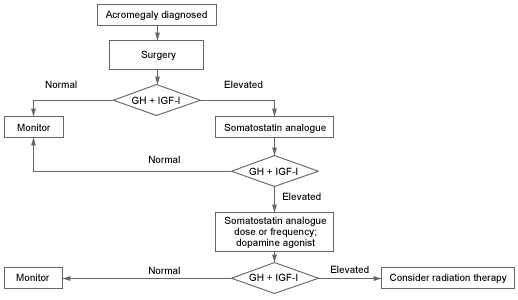
Adapted from Melmed et al.14
For more information about the recommended algorithm
for the treatment of acromegaly, click here
to submit a medical inquiry or call 888-NOW-NOVARTIS.
References:
| 1.
|
Acromegaly
Therapy Consensus Development Panel. Consensus
statement: benefits versus risks of medical
therapy for acromegaly. Am J Med.
1994;97:468-473. |
| 11.
|
Barkan
AL. Acromegaly. Diagnosis and therapy.
Endocrinol Metab Clin North Am. 1989;18:277-310.
|
| 13.
|
Barkan
AL, Halasz I, Dornfeld KJ, et al. Pituitary
irradiation is ineffective in normalizing
plasma insulin-like growth factor I in patients
with acromegaly. J Clin Endocrinol
Metab. 1997;82:3187-3191. |
| 14.
|
Melmed
S, Jackson I, Kleinberg D, et al. Current
treatment guidelines for acromegaly. J
Clin Endocrinol Metab. 1998;83:2646-2652.
|
| 15.
|
Harris AG. Treatment of acromegaly. In:
Daly AF, ed. Acromegaly and Its Management.
Philadelphia, PA: Lippincott-Raven; 1996:49-68.
|
|