|
|
 |
|
|
| The information contained
within this Web site is appropriate for U.S. residents only. |
|
|
|
Guidelines
for the Management of Diarrhea
The following guidelines have been published
concerning the management of diarrhea in neuroendocrine
tumors27:
Note: Since the publication of the guidelines, a
long-acting release formulation of Sandostatin®
Injection (Sandostatin LAR® Depot) (octreotide
acetate for injectable suspension) has been approved
for the long-term treatment of severe diarrhea and
flushing episodes associated with VIP-secreting
tumors—in patients who have been shown to respond
to and who can tolerate subcutaneous
Sandostatin® Injection.
Sandostatin
LAR® Depot (octreotide acetate
for injectable suspension)
A long-acting formulation of octreotide, Sandostatin
LAR® Depot, is now available, and offers potential
advantages including:
 |
Sandostatin
LAR® Depot is administered as an intragluteal
injection once every 28 days, a regimen that
may be preferred by physicians to minimize
compliance concerns. |
|
Serum
octreotide concentrations are more stable
and consistent with Sandostatin LAR® Depot
than with subcutaneous
Sandostatin® Injection. |
|
Clinical trials
of Sandostatin LAR® Depot confirm a therapeutic
benefit as good as subcutaneous
Sandostatin® Injection in reducing
GH levels, normalizing IGF-I levels, and in
controlling clinical symptoms. |
Subcutaneous
Sandostatin® Injection Dose Titration
The Diarrhea Management Consensus Development Panel
provides the following recommendations for the use
of subcutaneous
Sandostatin® Injection in the treatment
of secretory diarrhea27
|
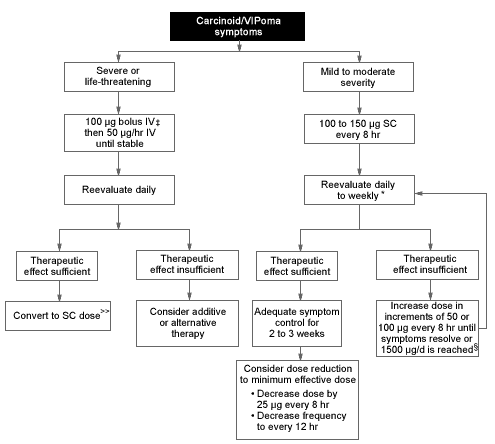
An
aggressive approach is used with subsequent
adjustment of the initial dose of subcutaneous
Sandostatin® Injection to achieve
control (Fig 6). |
|
An
initial dosage of 100 to 150 mg subcutaneously
every 8 hours is recommended in the treatment
of mild symptoms associated with carcinoid
syndrome. |
|
An
initial 100-mg bolus should be given, followed
by 50 mg/hour until patient is stable in the
treatment of profound secretory diarrhea.
|
|
An
aggressive dose-escalation regimen is recommended
to ensure rapid symptom relief: increase each
dose by 50 mg up to 200 mg every 8 hours if
needed, or increase dose in 100-mg increments
up to 500 mg every 8 hours. |
|
A slow, downward
titration can be instituted to ascertain minimal
effective dose after control is achieved:
a decrease of 25 mg per injection on a weekly
basis is recommended. |
Figure 6. Algorithm for subcutaneous
Sandostatin® Injection dose titration
in carcinoid syndrome and VIPomas.
Adapted with permission from Harris et al.27
* If symptoms warrant rapid control, reevaluate
daily.
» Daily requirements delivered in 3 to 4
equal subcutaneous doses.
‡ Increase dosage in 50 mg increments up
to 200 mg every 8 hr; then increase in 100-mg
increments from 200 up to a maximum of 500 mg
every 8 hr.
§ Maintenance dose should not be lower than
50 mg every 12 hr.
|
|
Adverse Effects for Subcutaneous Sandostatin®
Injection
Results from numerous studies of subcutaneous
Sandostatin® Injection in acromegaly,
VIPomas, and carcinoid syndrome have indicated
the following:
Clinical
Studies Using Subcutaneous Sandostatin® Injection
Improvement of Symptoms
Results of a number of studies revealed subcutaneous
Sandostatin® Injection dramatically reduced
the flushing and diarrhea associated with carcinoid
tumors.1,29-32 For example, a review
of 62 studies of Sandostatin® Injection treatment
of carcinoid syndrome showed the following27:
|
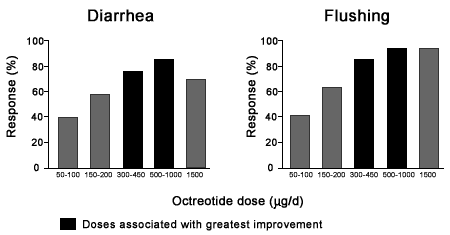
Improvement
in both flushing and diarrhea in up to 80%
of patients with carcinoid syndrome at doses
of 300 to 450 mg/day. |
|
Necessity
of aggressive dose escalation to ensure rapid
symptom relief and individualized dose titration
due to interpatient variability. |
|
Maximum response
occurred at doses of 500 to 1000 mg/day (Fig
7). |
Figure 7. Symptom relief with appropriate
subcutaneous
Sandostatin® Injection dosing.
Adapted with permission from Harris et al.27
Mechanism of Action
The mechanism by which subcutaneous
Sandostatin® Injection improves the gastrointestinal
(GI) symptoms in patients with carcinoid syndrome
was investigated by Saslow et al.33
They studied GI transit time in patients after
ingestion of a capsule containing radioactive
material and after injection with either subcutaneous
Sandostatin® Injection (50 mg) or placebo
tid. The authors reported the following ref:
|
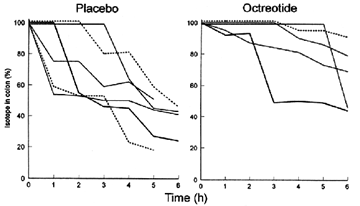
Subcutaneous
Sandostatin® Injection significantly
delayed overall transit time in the colon
in 4 of 5 patients (P<.05 vs. placebo).
(Fig 8) |
|
Subcutaneous
Sandostatin® Injection significantly
decreased circulating levels of: |
|
|
Peptide YY (P<.01) |
|
|
Neurotensin
(P=.02) |
|
|
VIP (P=.02) |
|
|
Substance P (P<.01) |
|
|
Subcutaneous
Sandostatin® Injection had no effect
on plasma levels of: |
|
|
Motilin (P=.10) |
|
|
Neuropeptide
Y (P=.14) |
|
|
Calcitonin gene-related peptide (P=.74)
|
|
|
Histamine (P=.25) |
|
|
The
authors concluded that motor dysfunctions
were underlying factors in the diarrhea observed
in carcinoid syndrome and that subcutaneous
Sandostatin® Injection has a beneficial
effect by improving motor function in the
GI system, specifically by increasing transit
time.33 |
Figure 8. Proximal colon emptying curves
in individual carcinoid patients receiving either
placebo (left) or 50 mg of octreotide (right).
The y-axis indicates the percentage of radioactivity
present in the ascending and transverse colon.
Note the prolongation of emptying in the subcutaneous
Sandostatin® Injection group overall.
Time 0 indicates the time when all of the radioactivity
was located in the ascending colon.
|
Clinical
Trials With Sandostatin LAR® Depot
The safety and efficacy of the Sandostatin LAR®
Depot formulation were evaluated in several different
clinical trials.
Study Objectives/Study Design
A 6-month, multicenter, parallel-group trial
with 93 patients was conducted to evaluate the
safety, tolerability, and efficacy of 10 mg, 20
mg, and 30 mg of Sandostatin LAR® Depot for
symptomatic relief of diarrhea and flushing in
patients with malignant carcinoid syndrome. This
trial was designed to show equivalence of the
Sandostatin LAR® Depot formulation to subcutaneous
Sandostatin® Injection, and not to differentiate
between the 3 groups. The study objectives were
the following:
The trial involved the following procedures:
Monthly Treatment Assessments
The primary efficacy variable, treatment response,
was defined as the
Supplemental medication was subcutaneous
Sandostatin® Injection at the same dosage
and schedule used during screening period for
patients receiving Sandostatin LAR® Depot
or increased by 50% for patients receiving subcutaneous
Sandostatin® Injection.
Treatment response was further defined as follows:
Serum Octreotide Concentrations
Pharmacokinetic (PK) analysis was performed only
for the Sandostatin LAR® Depot groups since
the PK profile was already established for Sandostatin®
Injection. The following results were reported34:
|
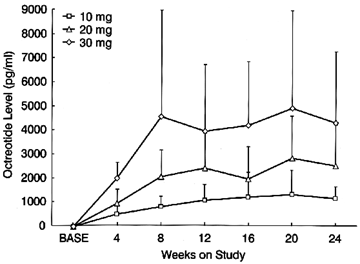
Mean
trough octreotide concentrations reached steady
state by week 8 in the 20-mg and 30-mg groups
and by week 12 in the 10-mg group (Fig 9).
|
|
Octreotide trough concentrations with Sandostatin
LAR® Depot given every 4 weeks for 20
weeks were dose-dependent and proportional
to the dose. Mean steady-state octreotide
concentrations were in the range of 1000
to 4000 pg/mL for all 3 Sandostatin LAR®
Depot groups.
|
Figure 9. Mean serum octreotide concentration
(pg/mL) after IM administration of Sandostatin
LAR® Depot at 10 mg (n=16), 20 mg (n=13),
or 30 mg (n=19) every 4 weeks.
From Rubin et al.34
|
|
Treatment Success and Partial Treatment Success
at Week 20
and/or Week 24
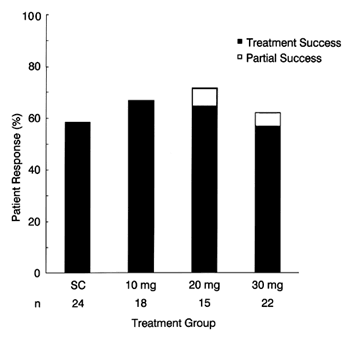
The reported results on treatment success were
the following34:
|
The
rates of treatment response at weeks 20 and
24 (after the 5th and 6th injections) were
similar across treatment groups (Fig 10).
|
|
No
association was noted between the rates of
complete treatment success and octreotide
level once the steady-state octreotide serum
concentrations were reached and consistent
octreotide serum concentrations above 1000
mg were observed, and there was no association
between treatment response and sex or age.
|
Figure 10. Percentage of patients with
treatment success and partial treatment success
at week 20 and/or week 24 by treatment group.
From Rubin et al.34
Percentage of Patients Requiring Supplemental
Medication During the Treatment Period
Patients who experienced a loss of symptomatic
control (increased stool frequency of 2 per day
or increased flushing episodes by 3 per day for
1 day) during the study period were permitted
to use supplemental medication every 8 hours until
symptoms returned to pre-washout frequency for
24 hours. Supplemental medication was subcutaneous
Sandostatin® Injection at the same dosage
used during the screening period for patients
receiving Sandostatin LAR® Depot or increased
by 50% for patients receiving subcutaneous
Sandostatin® Injection. The following
results were reported34:
|
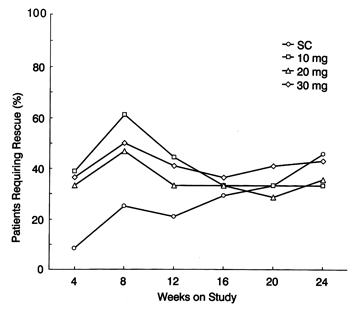
The
need for supplemental medication was similar
in all 4 groups from week 16 (when steady
state could be expected to be achieved in
the Sandostatin LAR® Depot group) through
the end of the trial (Fig 11). |
|
The
percentage of patients requiring supplemental
medication was highest in the 10-mg Sandostatin
LAR® Depot group. |
|
Only
36% of the patients in the 20-mg Sandostatin
LAR® Depot group required supplemental
medication at week 24 compared with 46% of
the patients receiving subcutaneous
Sandostatin® Injection. |
Figure 11. Percentage of patients requiring
rescue in each treatment group during the 24-week
treatment period.
From Rubin et al.34
Median Number of Rescue Doses
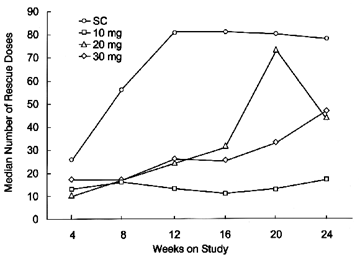
The subcutaneous
Sandostatin® Injection patients who used
supplementary rescue doses consistently required
a higher median number of doses for each 4-week
treatment interval than the patients in the Sandostatin
LAR® Depot groups (Fig 12). Patients in the
10-mg Sandostatin LAR® Depot group used the
smallest median number of rescue doses.34
Figure 12. Median number of supplemental
subcutaneous
Sandostatin® Injection doses taken by
patients requiring rescue during the preceding
4-week interval by treatment group. The data for
week 4 only include supplemental doses taken after
day 11.
From Rubin et al.34
Median Number of Stools per Day
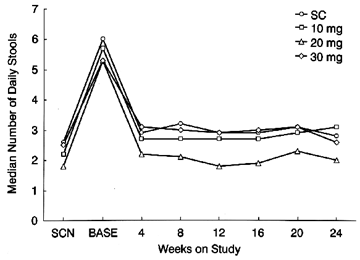
The median number of daily stools decreased significantly
from washout levels in all treatment groups and
were similar across treatment groups (Fig 13).34
Figure 13. Median number of stools per
day in 47 patients throughout screening (SCN),
baseline (BASE), and 24-week treatment period
by treatment group.
From Rubin et al.34
Median Number of Flushing Episodes per Day
The number of flushing episodes was not significantly
different between treatment groups throughout
the trial (Fig 14). The number of flushing episodes
was higher for the 10-mg and 30-mg Sandostatin
LAR® Depot groups than the subcutaneous
Sandostatin® Injection group until week
8 and continued to be higher throughout the study
in the 10-mg group, although the differences were
not statistically significant.34
Figure 14. Median number of flushing episodes
per day in 33 patients throughout screening (SCN),
baseline (BASE), and 24-week treatment period
by treatment group.

From Rubin et al.34
Summary
Safety
Results
Sandostatin LAR® Depot was at least as well
tolerated as subcutaneous
Sandostatin® Injection, and tolerability
was similar in all 4 treatment groups. The following
results were reported34:
Adverse Events for Sandostatin LAR® Depot
Results from numerous studies of Sandostatin
LAR® Depot in carcinoid syndrome and VIPomas
have indicated the following:
Conclusions
|
Sandostatin
LAR® Depot provides efficacy comparable
to subcutaneous
Sandostatin® Injection with a similar
safety profile and the benefit of a once-monthly
injection. |
|
Sandostatin LAR®
Depot is an alternative to subcutaneous
Sandostatin® Injection with the potential
to improve patient compliance and satisfaction
with therapy, leading to successful clinical
control of the carcinoid syndrome. |
|
References:
| 1.
|
Norton
JA, Levin B, Jensen RT. Cancer of the endocrine
system. In: DeVita VT Jr, Hellman S, Rosenberg
SA, eds. Cancer: Principles & Practice
of Oncology. 4th ed. Philadelphia, PA: JB
Lippincott; 1993;2:1333-1435. |
| 22.
|
Anderson
AS, Krauss D, Lang R. Cardiovascular complications
of malignant carcinoid disease. Am
Heart J. 1997;134:693-702. |
| 27.
|
Krejs
GJ. Diarrhea. In: Bennett JC, Plum F, eds.
Cecil Textbook of Medicine. 20th ed. Philadelphia,
PA: WB Saunders; 1996;689-695. |
| 28.
|
Longe
RL, DiPiro JT. Diarrhea and constipation.
In: DiPiro JT, Talbert RL, Hayes PE, et al,
eds. Pharmacotherapy. 2nd ed. Norwalk, CT:
Appleton & Lange; 1993:566-570. |
| 29.
|
Lancranjan
I, Bruns C, Grass P, et al. Sandostatin
LAR: pharmacokinetics, pharmacodynamics, efficacy,
and tolerability in acromegalic patients.
Metabolism. 1995;44:18-26. |
| 30.
|
Harris
AG. Treatment of acromegaly. In: Daly AF,
ed. Acromegaly and Its Management.
Philadelphia, PA: Lippincott-Raven; 1996;49-68.
|
| 31.
|
Sandostatin
LAR® Depot (octreotide acetate for injectable
suspension) prescribing information. East
Hanover, NJ: Novartis Pharmaceuticals Corporation;
1998. |
| 32.
|
Oberg
K. Interferons in the management of neuroendocrine
tumors and their possible mechanism of action.
Yale J Biol Med. 1992;65:519-529. |
| 33.
|
Wallace
S, Ajani JA, Charnsangavej C, et al. Carcinoid
tumors: imaging procedures and interventional
radiology. World J Surg. 1996;20:147-156.
|
| 34.
|
Caplin
ME, Buscombe JR, Hilson AJ, et al. Carcinoid
tumour. Lancet. 1998;352:799-805.
|
|
|
| |
|
|