|
Epidemiology
Gastroenteropancreatic (GEP) tumors are rare, with
an incidence of 1.5 cases per 100,000 of the population
affecting approximately 6000 people in the United States.
Types of GEP tumors according to incidence include the
following1:
Pathophysiology Definition
of Carcinoid Tumors
Carcinoid tumors originate from the diffuse neuroendocrine
system, specifically the enterochromaffin (EC) cells.
EC cells are widely distributed throughout the body,
but are most prevalent in the submucosa of the intestine
and main bronchi.2 Carcinoid tumors have
the following characteristics2:
Carcinoid tumors are classified by site
of origin (ie, foregut, midgut, hindgut), because histochemistry,
secretory products, and manifestations vary with location.
 |
Primary
occurrence in the appendix (38%), ileum (23%), rectum
(13%), and bronchus (11.5%).2 |
|
Occurrence with an incidence
of less than 1% in the pancreas, gallbladder, liver,
ovaries, larynx, and testes, but these tumors have
a high incidence of metastases.2,3 |
Carcinoid
Syndrome
Definition
Malignant carcinoid syndrome, the predominant
clinical feature of carcinoid tumors, results from excessive
secretion of hormone products into the systemic circulation
(Table 1). These hormones (peptides and amines) cause
the extreme symptoms of the disease, and a reduction
in their circulating blood concentrations is a therapeutic
goal of treatment.1,2
Table 1. Gastrointestinal Peptides and
Amines Secreted by Carcinoid Tumors
ACTH
Gastrin
Pancreatic polypeptide
Insulin
Tachykinins
Vasoactive intestinal polypeptide (VIP)
Serotonin
5-hydroxyindoleacetic acid (5-HIAA)
Serotonin
Metabolism in Carcinoid Syndrome
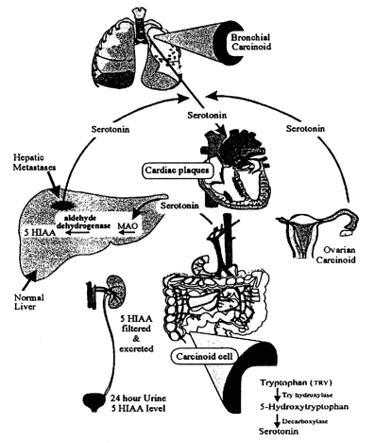
Carcinoid syndrome results from hypersecretion
of bioactive amines and peptide hormones. Many of the
symptoms of carcinoid syndrome are produced by serotonin
or its metabolites. Serotonin metabolism in carcinoid
disease is illustrated in Figure 1.4
Figure 1. Serotonin metabolism in
carcinoid disease. Primary carcinoid tumors of gastrointestinal
tract, ovary, bronchus, and heptatic metastases. TRY=Tryptophan;
MAO=monoamine oxidase.
Development
of Carcinoid Syndrome
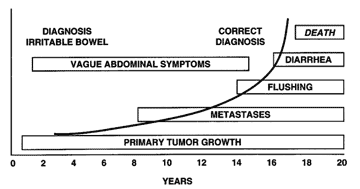
Carcinoid syndrome does not usually develop
until a tumor has metastasized – usually to the
liver – and the hormonal products released by the
tumor reach the circulation in substantial concentrations.5,6
Figure 2. Progression of carcinoid
disease.
Reprinted with permission from Vinik et
al.1
|
Patient
age at diagnosis ranges widely – from 10 to
93 years; however, carcinoid tumors are most frequently
reported between 50 and 70 years with a mean of
approximately 55 years.2 |
|
Overall, the prognosis
for patients with carcinoid tumors is relatively
good compared with other malignancies.1
|
Clinical
Symptoms of Carcinoid Syndrome
A variety of different symptoms
are associated with carcinoid syndrome (Fig 3):
Figure 3. Clinical presentation of carcinoid syndrome.

Data from Creutzfeldt et al.10
|
Flushing,
the most frequent symptom, may occur spontaneously
or be precipitated by stress, alcohol, certain foods,
exercise, or pharmacologic agents. Flushing episodes
may be brief (2 to 5 minutes) or last for several
hours, particularly in later stages of the disease.5
|
|
Diarrhea
usually accompanies flushing but occurs alone in
approximately 15% of cases; abdominal pain or cramping
may or may not be associated with
diarrhea.5 |
|
Other symptoms include a unique type of endocardial
fibrosis and wheezing or asthma-like symptoms.5
|
|
Myopathy, arthritis,
arthralgias, and changes in mental state are reported,
although only rarely.5 |
Carcinoid Heart Disease
Carcinoid heart disease develops in about
50% to 60% of patients with carcinoid syndrome.4
Survival
of Patients With Carcinoid Syndrome
After the onset of clinical symptoms,
median survival times of 3.5 to 8.5 years have been
reported; 5-year survival has ranged from 30% to 67%.2
VIPomas
VIPomas are rare endocrine tumors that
occur with an annual incidence of 1 per 10 million.12
VIPomas are
|
Often large,
solitary tumors that occur primarily (80% to 90%)
in the pancreas2 |
|
Characterized by dramatic
symptoms (Table 2) |
| Table
2. Clinical Presentation of VIPoma Syndrome |
| Symptom
Frequency of Occurrence |
(%) |
| Secretory
diarrhea |
100 |
| Hypokalemia |
100 |
| Dehydration |
100 |
| Hypochlorhydria |
70 |
| Hypercalcemia
|
41 |
| Flushing |
21 |
Data from Norton et al.2
|
Associated
with secretory diarrhea, a major marker of VIPoma
syndrome, which is severe and of a high volume,
ie, usually more than 3 L/day2,12 |
|
Diagnosed
based on the demonstration of elevated VIP in plasma
and presence of large volume secretory diarrhea2
|
|
Associated with VIPoma syndrome, often referred
to as pancreatic cholera, Verner-Morrison syndrome,
or watery diarrhea, hypokalemia, and achlorhydria
(WDHA)2,12,13
|
References:
| 1.
|
Acromegaly
Therapy Consensus Development Panel. Consensus
statement: benefits versus risks of medical therapy
for acromegaly. Am J Med. 1994;97:468-473.
|
| 2.
|
Bates AS,
Van't Hoff W, Jones JM, et al. Does treatment
of acromegaly affect life expectancy? Metabolism.
1995;44(suppl 1):1-5. |
| 3.
|
Rajasoorya
C, Holdaway IM, Wrightson P, et al. Determinants
of clinical outcome and survival in acromegaly.
Clin Endocrinol. 1994;41:95-102. |
| 4.
|
Melmed S.
Acromegaly. N Engl J Med. 1990;322:966-977.
|
| 5.
|
Harris AG.
Physiology of growth hormone. In: Daly AF,
ed. Acromegaly and Its Management. Philadelphia,
PA: Lippincott-Raven; 1996:9-16. |
| 6.
|
Thorner
MO, Vance ML, Horvath E, et al. The anterior
pituitary. In: Wilson JD, Foster DW, eds. Williams
Textbook of Endocrinology. 8th ed. Philadelphia,
PA: WB Saunders; 1992:221-310. |
| 7.
|
Melmed S,
Ho K, Klibanski A, et al. Clinical review 75:
recent advances in pathogenesis, diagnosis, and
management of acromegaly. J Clin Endocrinol
Metab. 1995;80:3395-3402. |
| 8.
|
Lamberts
SWJ, van der Lely AJ, de Herder WW, et al. Octreotide.
N Engl J Med. 1996;334:246-254. |
| 9.
|
Harris AG.
Diagnosis of acromegaly. In: Daly AF, ed.
Acromegaly and Its Management. Philadelphia,
PA: Lippincott-Raven; 1996:38-48. |
| 10.
|
Lombardi
G, Colao A, Marzullo P, et al. Is growth hormone
bad for your heart? Cardiovascular impact of
GH deficiency and of acromegaly. J Endocrinol.
1997;155:S33-S37. |
| 11.
|
Barkan AL.
Acromegaly. Diagnosis and therapy. Endocrinol
Metab Clin North Am. 1989;18:277-310. |
| 12.
|
Krejs GJ.
VIPoma syndrome. Am J Med. 1987;82:37-48.
|
| 13.
|
Buchanan KD. Effects
of Sandostatin on neuroendocrine tumours of the
gastrointestinal system. Recent Results Cancer
Res. 1993;129:45-55. |
|